what happened to american indians after 1492? quizlet
Native Americans in Colonial America
Native Americans in Colonial America
Native Americans resisted the efforts of the Europeans to gain more than country and command during the colonial period, merely they struggled to do so against a sea of problems, including new diseases, the slave merchandise, and an ever-growing European population.
Subjects
Geography, Human Geography, Social Studies, U.South. History
Paradigm
Affairs between Cheyenne and Settlers
Whether through diplomacy, war, or fifty-fifty alliances, Native American efforts to resist European encroachment further into their lands were often unsuccessful in the colonial era. This woodcut shows members of the Cheyenne nation conducting affairs with settlers of European descent in the 1800s.
Photo of woodcut by North Wind Moving picture Archives

During the colonial menstruation, Native Americans had a complicated relationship with European settlers. They resisted the efforts of the Europeans to gain more of their land and control through both warfare and diplomacy. But issues arose for the Native Americans, which held them dorsum from their goal, including new diseases, the slave trade, and the ever-growing European population in N America. In the 17th century, as European nations scrambled to claim the already occupied land in the "New World," some leaders formed alliances with Native American nations to fight foreign powers. Some famous alliances were formed during the French and Indian War of 1754–1763. The English language allied with the Iroquois Confederacy, while the Algonquian-speaking tribes joined forces with the French and the Spanish. The English won the war, and claimed all of the land e of the Mississippi River. The English language-allied Native Americans were given part of that country, which they hoped would end European expansion—but unfortunately only delayed it. Europeans continued to enter the country post-obit the French and Indian State of war, and they connected their aggression against Native Americans. Another result of allying with Europeans was that Native Americans were often fighting neighboring tribes. This acquired rifts that kept some Native American tribes from working together to cease European takeover. Native Americans were as well vulnerable during the colonial era because they had never been exposed to European diseases, similar smallpox, then they didn't have any immunity to the disease, as some Europeans did. European settlers brought these new diseases with them when they settled, and the illnesses decimated the Native Americans—by some estimates killing as much as 90 per centum of their population. Though many epidemics happened prior to the colonial era in the 1500s, several large epidemics occurred in the 17th and 18th centuries amid various Native American populations. With the population ill and decreasing, it became more and more hard to mountain an opposition to European expansion. Another attribute of the colonial era that made the Native Americans vulnerable was the slave trade. As a outcome of the wars between the European nations, Native Americans allied with the losing side were often indentured or enslaved. There were even Native Americans shipped out of colonies like South Carolina into slavery in other places, like Canada. These problems that arose for the Native Americans would only get worse in the 19th century, leading to greater confinement and the extermination of native people. Unfortunately, the colonial era was neither the kickoff nor the terminate of the long, night history of treatment of Native Americans by Europeans and their decedent'southward throughout in the United States.
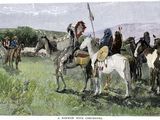
Whether through diplomacy, state of war, or even alliances, Native American efforts to resist European encroachment further into their lands were often unsuccessful in the colonial era. This woodcut shows members of the Cheyenne nation conducting diplomacy with settlers of European descent in the 1800s.
Photograph of woodcut by N Current of air Picture Archives
alliance
Noun
people or groups united for a specific purpose.
colonial expansion
Noun
spread of a foreign say-so over other territories, usually through the establishment of settlement communities.
colonialism
Noun
type of government where a geographic area is ruled past a foreign power.
confine
Substantive
boundary or limit.
consequence
Noun
result or upshot of an action or situation.
Substantive
art and science of maintaining peaceful relationships between nations, groups, or individuals.
Noun
outbreak of an infectious disease able to spread rapidly.
expansion
Noun
procedure of enlarging.
extermination
Noun
targeted killing of a group of things.
indentured servant
Noun
person under contract to work for some other over a period of time.
slave trade
Substantive
traffic in slaves.
smallpox
Noun
very contagious, often fatal disease wiped out with vaccination programs.
tribe
Noun
community made of one or several family unit groups sharing a common culture.
savagewenbestaide.blogspot.com
Source: https://www.nationalgeographic.org/encyclopedia/native-americans-colonial-america/
0 Response to "what happened to american indians after 1492? quizlet"
Post a Comment